Symbolic reinterpretation of the Rape of Europe myth

Valentin Serov
The Rape of Europe (1910)
State Tretyakov Gallery, Moscow
There is something odd about her. It is not that she is being abducted. By “odd” I mean that there is a contrast, not that something bad is necessarily happening. Her appearance in Valentin Serov’s painting is tilted towards its “captor”; she is smiling. At first glance, it may feel as if this painting is trying to normalize the abduction. Moreover, Zeus, represented as the bull, takes her without opposition, as she seems to accept her destiny.
But every time I look at it, there is something odd.
Because of her body language, the way she smiles, the way she holds herself, as if she feels safe. I am going to say this as soon as possible to avoid misunderstandings.
The bull is a woman.
This representation does not depict the traditional myth of Zeus abducting Europa. It holds more meaning than that. To explain myself, and the oddness I am presenting, she is not being controlled; she is controlling. There is no fight, only flow towards somewhere, looking back with a face of remorse. I see it as if nature is guiding her towards a better life.
Nature as knowledge, as wisdom, as a presence that fully comprehends the one being carried, a presence connected to the earth. To my understanding, there is nothing closer to this than a woman, leading me to conclude that nature is a feminine energy.
A better life understood as a life she is able to choose by herself.
In this piece, the dolphins appear to reinforce the discourse about the force of nature, as does the sea, which is turbulent everywhere except where she is moving. A red bull, red like clay, like earth.
The leaves of the broken crown appear to be carried away, as if they were the last remnants of a world that is disappearing.
It is not an abduction; it is a departure.
A goodbye without asking permission, nor being sorry for it.
Introducing another artwork
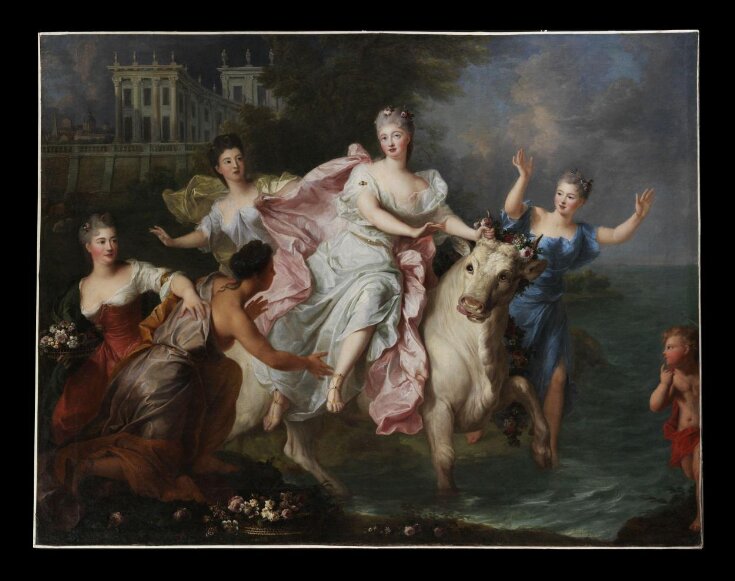
Pierre Gobert
The Rape of Europa (c. 1690–1700)
Victoria and Albert Museum, London
This other representation, which I saw at the Victoria and Albert Museum in London during my last stay, immediately caught my attention. It behaves, in some ways, similarly to Serov’s work. This time, however, we are witnessing the moment just before the departure.
We are confronted with a chaotic composition, where one might more easily assume that this is an abduction. However, what I perceive is the bull asking Europa for permission, as if she were the one deciding. Just before entering the water, as if asking:
Should I jump?
Europa does not answer. Instead, she looks towards his head. Her legs point towards the sand but remain lifted, as if there were still a chance not to go. Yet her willingness, her heart, points towards the sea. Not only her hands, but the front of her upper body is directed there, not towards the bull. Lastly, she stares directly ahead. The head is the only part of her body that appears balanced. It is a decision she has already made.
You might now be thinking about the other women. Aren’t they women as well? Yes, they are. But what is happening, for me, differs from what it may initially seem. I will go through them one by one, from right to left.
The woman in the blue dress, occupying the exit but not entirely, appears almost to be smiling. She allows the escape.
The woman in the light blue dress seems repulsed by the idea of Europa leaving, yet she does not direct this rejection towards the bull. Instead, she stares directly at Europa, as if she knows who is choosing.
The woman in the greyish dress could be interpreted in two ways. Either she is signalling to go ahead, or she behaves this way because of another presence, a figure of higher status, introduced next.
The woman in the red dress. Red as the colour of desire. She looks in the opposite direction to where Europa is heading. It feels to me that she is the one who will gain status once Europa is removed, perhaps symbolically, as strength within the group. She pushes down the only figure that appears to be trying to retrieve Europa. In this sense, she feels like the one reclaiming the position of the departing figure, driven by the desire to be more.
The castle I understand not merely as a reference to power, but as the division between two worlds. Society and the openness of the sea. What is left behind on the left, and what feels right to pursue on the right.
The last agent is Eros, also known as Cupid. He is there to read the situation, to understand it. His presence affects everyone, allowing their desires to become explicit, as described above. He is an agent of nature, the one who helps her. Please do not misunderstand me. In representation, if nature is feminine, a child becomes the active agent. I do not present Eros simply as a boy, but as a child, a being not yet fixed or defined.
Why is the agent of nature not a woman? Perhaps because nature is everything. I believe part of it exists within all of us, but it must be found individually. Nature does not impose; it allows choice.
I know this is a conflictive topic. That is why I call this blog naïf. Completely spontaneous, natural, and non-artificial so you will be reading more like this as soon as I feel like it.
Maties

Comments
Post a Comment